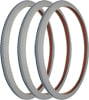
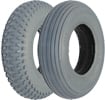
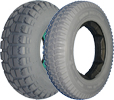
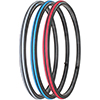
Pnuematic Tires - These are the tires that have an inner tube. Inner tubes are sold separately and are generally ordered with the tire. It's best to change both the tire and tube at the same time. These tires are usually grey and have various tread patterns. Air tires offer many benefits. The air pressure can be adjusted for softer ride or increased for better performance. These absorb road shocks and bumps better than any wheelchair tire. They can go flat (especially runing over a sharp object) and require periodic maintenance of filling the tire with air.
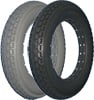
Foam Filled Tires - These are grey or dark grey pneumatic tires that are filled with foam during the manufacturing process. They are maintenance-free, flat-free, and require no air. They provide a firmer ride over air filled tires. These tires require a two piece wheel and may or may not be more difficult to install (see installation instructions below). If you want to upgrade from a pnuematic tire (and have a two piece rim), you may need the inside bead to inside bead width of your existing rim. Ideally you want the foam filled tire to be a little wider than the inside bead dimension you measured so that when the tire is installed, there is enough compression to keep the tire from spinning on the rim. Each foam filled tire page will show you how to measure and at the bottom of this page is a video on how to measure.
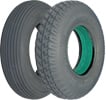
Heavy Duty Foam Filled Tires - Similar to the other foam filled tires, but with a specially formulated foam material. They are available in a limited number of sizes and bead measurements. They give a very hard ride, but are made to handle maximum weight, such as with a bariatric chair. Again, a two piece wheel is required and you may need the bead to bead width. Each foam filled tire page will show you how to measure and at the bottom of this page is a video on how to measure. Urethane Tires - Made from solid urethane, these are solid tires, maintenance free, and air free. These tires wear longer than other tires, have a firm ride, and may or may not be more difficult to install. In some situations, knobby tires have been known to chunk. Most of the smaller urethane tires require a two piece wheel and the larger sizes do not.
Which Wheelchair or Scooter Tire Should I Buy?
Ordering a new set of tires for your wheelchair or scooter is not as difficult as you might think. Knowing the size, tread pattern, and make & model of your chair or scooter makes the process much easier, so note that information before you begin:
Tire size? The easiest way to know what size to purchase is to look on the sidewall of the existing tire. The number can be metric, standard or both. If you have only the rim and not the tire, we found a good link here to help you measure the rim: Sheldon Brown. This page was created for measuring bicycle rims but will work just as well for wheelchairs and scooter rims. You can also contact the manufacturer of your wheelchair or scotter to see if they know what size will fit on your rim. We do not recommend changing the size tire that came with your wheelchair or scooter even if it will fit on your rim. Your chair or scooter was designed and engineered with the tire size that came with it and changing it could pose a safety risk.
Tire type? Note if it is air filled, foam filled, or solid tire
Tread pattern? A number printed on the sidewall indicating the tread pattern. Usually starting with a letter (but not always), it may be hard to pick out of all the numbers on the sidewall. For the tires we sell, most of the tread pattern numbers are written in the product description, so you can search for your size in one of the categories above to see what the numbers might be for confirmation. For some tires sizes, we have multiple tread patterns available so you may have to check several.
Wheel or caster type (single or two piece)? Important if you plan to upgrade your tire to a solid or foam filled tire. Most smaller foam filled or urethane tires require a two piece rim to install.
Make & model of your chair or scooter? Sometimes the same size tire is available in two or three different models for specific chairs.
Selecting the right tire type depends on what the chair is being used for and what your preferences are. For most of us, if you are happy with what you have and are able to properly maintain them (ie. filling the tire with air periodically), then go with the same type you already have. If you want to change what type of tire you have, consider the following attributes: puncture resistance, ride quality, traction, rider weight, maintenance.
Puncture resistance - If this is a primary concern, go with a solid or foam filled tire (you will probably need a two piece wheel or caster to install). Consider also thorn resistant inner tubes.
Ride quality - Air filled or a combination of both air and foam (or urethane) - Some people use air filled in the front and solid or foam filled in the rear) for a smoother ride. Thorn resistant inner tubes are a good option for the rears if punctures are a concern and you prefer air filled tires (if they are available in your size).
Traction - some tire sizes have several tread pattern options available. Knobby tires generally perform better in low traction situations.
Rider weight - if you have a bariatric chair, solid urethane tires or heavy duty foam filled tires may be a good option.
Maintenance - If you are unable to fill the tire with air or don't have someone you can partner with stay away from air filled tires. Natural air loss through the wall of an inner tube occurs about 25% every month even with no use). Foam filled tires or urthane tires require no air and are completely flat free.
Installing Your Wheelchair or Scooter Tires
Tire installation on a wheelchair or scooter is not very difficult if you have the right tools. In fact most manual chair tire changeouts are done the same as on a bicycle. If you're not comfortable or cannot perform this task, ask around to your friends and family. Maybe one of them will be able to help. You can also check with a local bike shops as they may be able to help.
Tools needed: A pump compatible with the valve, air pressure gauge (or a pump with a built in gauge), and tire levers. For 2 piece rims, you'll need a phillips or flat head screwdriver. Some 2 piece rims are screwed together with bolts, so you may need a properly sized socket.
Tire removal for one piece rim
Remove the wheel from the wheelchair or scooter - never try to change a tire or tube with the wheel on the chair!
If using inner tube, let the air out of the tire. For Schrader valves, press the stem in the middle of the valve. For Presta valves, unscrew the top and press in.
Once the air is out, press the sidewall of the tire all around to release the bead of the tire from the rim (tire beads can stick sometimes).
If your valve has a nut holding it to the rim, unscrew it
If removing a urethane tire, push on the side wall of the tire while inserting a lever bar. Some urethane tires are quite a bit smaller than the rim they are on so this can be difficult. Once one lever is in, insert a second lever and push the tire over the rim - it should come off.
If removing a tire with tube, use a couple of tire levers and ease the tire off the rim by working the levers under the bead, then moving the lever around the rim until one side of the tire is off the rim. Then do the same for the other bead going in under both from the same side. If using metal tire levers, use caution so as not to damage the rim.
Once the tire is off the rim, inspect the rim for damage. Also look at the tire liner if you have one and make sure it is still properly seated on the rim.
Tire re-installation for one piece rim
If using an inner tube, inflate the tube slightly to give it a little shape and put the tube into the tire and push the valve through the hold in the rim. Be careful to align the valve stem through the hole so it seats properly later when the tube is filled with air. For a urethane insert, just push it into the tire.
Slide the first side of the tire bead all the way around the rim until that side is completely on. You may or may not need lever bars for this step.
Ease the second bead over the rim and using lever bars work the bead all the way around the rim until the bead is completely on. You'll need a minimum of two lever bars for this step - one for holding your progress and the other for stretching the bead over the rim as you near the end. Some people will find this step challenging as it can be very tough to lift the last part over the rim. Patience really helps. If you are using metal lever bars, use extreme caution so you don't damage the rim.
Once the tire is on the rim, push on the sides of the tire all the way around to make sure the tube isn't bunched up or pinched anywhere.
Inflate the tire to the recommended pressure by the wheelchair or scooter manufacturer or the number on the sidewall of the tire. Install the valve stem screw (if your valve has one).
For a urethane tire, start on one spot on the wheel and keep working the tire around the rim with your hands until it becomes difficult, then use a couple of lever bars to force the tire over the rim. Slotted metal lever bars work well with this step, but extreme caution should be used as you don't want to damage the rim. You may want to leave the urethane tire in the sun for a while to heat it up (urethane tires are sometimes much smaller than the rim so that when they are installed, they will not pose a safety concern). Heating them makes them easier to stretch.
Before reattaching the wheel to the chair, visually inspect the tire to make sure the tire seats evenly all the way around the rim - if not, deflate the tube and re-work the tire with your hands to properly align, then re-inflate.
Tire removal and re-installation for two piece rim
Remove the wheel from the wheelchair or scooter - never try to change a tire or tube with the wheel on the chair!
If your tire has a tube, let the air out of the tire. For Schrader valves, press the stem in the middle of the valve. For Presta valves, unscrew the top and press in.
Using the appropriate tool, take off the screws or bolts and save for later re-installation
Lift off the top half of the rim and set aside. If the two halfs are stuck together, you can drop the tire and wheel assembly on to your work surface from about a foot up. Be careful to drop the assemaly onto the deflated tire only. Both halfs should come apart.
If your wheel has bearings and a bearing spacer they may fall out. They can be re'installed later with a rubber mallet once the tire/tube process is finished.
If your tire has an inner tube, or a urethane inner tube insert, pull it out of the tire and save for later re-installtion (if it is still good).
Inspect both halves of the rim for damage and for any debris that may have caused a flat.
If using an inner tube, inflate it a little to give it some shape and insert into the tire. If you are using a urethane insert, just push it into the tire.
Seat the tire ontop of one half of the rim and insert the valve through the hole (for inner tube). If you are installing a urethane tire or foam filled tire, the hole will not be used.
Place the top half of the rim onto the assembly and reattach the screws or bolts as before. You want them tight, but do not overtighten. If you are installing foam filled tires, you may need to press the two halves together with some force. For really tough tires, consider a foam filled tire installation tool - see video of this tool in action below.
For inner tubes, inflate to the pressure as recommended by the wheelchair or scooter manufacturer or the pressure listed on the side wall of the tire (for inner tube).
Visually inspect the tire and wheel to make sure everything is straight and aligned. If not, you will have to deflate the tube, reposition the tire/tube and re-inflate.
If the bearings came out during the removal process, you can pound them back in using a rubber mallet (only use a rubber mallet, or a block of wood wrapped in a towel. with a hammer - and use as little force as you need). Make sure to insert the bearing spacer first if you have one.